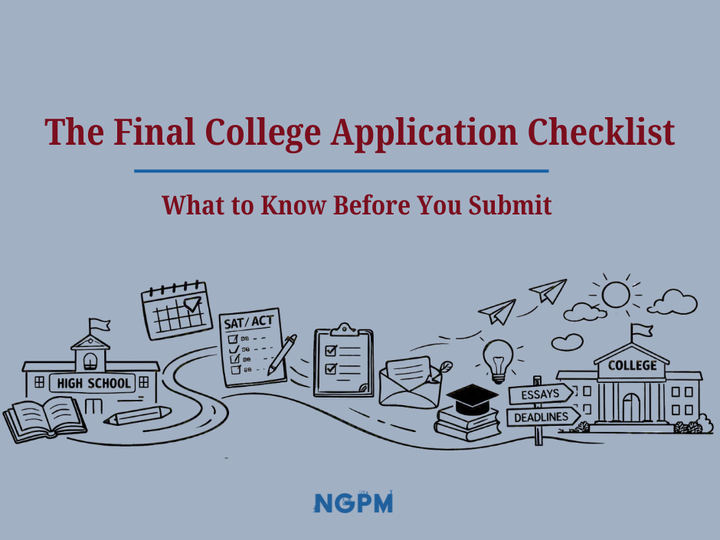
The Final College Application Checklist: What to Know Before You Submit
You're about to submit your college applications, here are a few things to keep in mind before you do.

For seniors, September is when college applications start to feel real.
You may have spent the summer researching schools, building your college list, brainstorming essays, or organizing activities. Now, deadlines are getting closer and all of those separate pieces have to come together into an actual application.
That can feel overwhelming, especially when every college seems to have different deadlines and requirements. The good news is that you do not have to finish everything at once.
At this point, the goal is pretty simple: stay organized, tell your story clearly, and make sure the small details do not get lost along the way.
Here is a final checklist to help you get from September to submission season.
1. Start With One Master Application Tracker
Before worrying about individual essays or supplements, make sure you know exactly what you are applying to and when everything is due.
Find one organization system that works for you and stick with it. This could be a spreadsheet, your calendar, Notion, or even a simple checklist. The specific tool does not matter nearly as much as having one place where you can see every deadline and requirement.
For each college, keep track of:
- Application deadline
- Early Action, Early Decision, or Regular Decision plan
- Personal statement and supplemental essays
- Recommendation requirements
- Transcript and counselor requirements
- Standardized testing policy
- Financial aid deadlines and required forms
- Scholarship or honors program deadlines
NACAC recommends creating a calendar that tracks application deadlines, standardized testing, financial aid deadlines, essays, recommendations, and other required materials.
Do not assume every deadline at a college is the same. An honors program or scholarship may have a different deadline from the general application.
It can also help to give yourself a personal deadline a few days before the real one. Submitting an application you have had time to review is much less stressful than trying to fix everything at 11:58 PM.
2. Make Sure Your Common App Actually Tells Your Story
When you spend weeks working on different parts of an application, it is easy to forget that an admissions officer eventually reads those pieces together. Before submitting, look at your Common App as one complete application.
Use each section to add something new. Your personal statement does not need to summarize your résumé, and your activities section does not need to explain your entire personality. If you are interested in medicine, not every activity needs to somehow connect back to healthcare either.
At the same time, the different parts of your application should still feel like they belong to the same person. Before submitting, think about a few things you genuinely want a college to understand about you. Maybe that is your curiosity, commitment to service, creativity, leadership, interest in a particular field, or something completely different. Then look at your application as a whole and ask yourself: Does someone reading this actually come away understanding those parts of me?
Your activities might show what you spend your time doing, your personal statement might reveal how you think or what has shaped you, and your supplemental essays can show how your interests connect specifically to that college.
This is also where researching individual schools becomes useful. You should not change who you are depending on the college, but you can decide which genuine parts of your interests are most relevant to highlight. If a school has a program, community, research area, or opportunity that strongly connects with something you already care about, your supplements are a great place to make that connection.
3. Do Not Undersell Your Activities
The activities section gives you very limited space, so how you describe an experience matters.
Try to focus on what you actually did, rather than simply repeating the name of your position or organization.
Instead of:
“Member of Science Club. Attended meetings and participated in activities.”
Think more like:
“Led experiment demonstrations for younger students and helped organize the club’s annual science outreach event.”
The second description gives the reader a much clearer idea of the student's role.
Whenever possible, think about:
- What did I actually do?
- Who did I work with or help?
- Did I create, lead, organize, teach, research, or improve something?
- Is there a specific result or impact I can describe?
You do not need to make every activity sound life-changing. Do not exaggerate what you did, but do not undersell it either.
4. Use Supplemental Essays to Add Something New
Supplemental essays can start to feel repetitive, especially when several colleges ask similar questions.
But they are also another opportunity to show something that may not appear elsewhere in your application.
For a “Why Us?” essay, avoid stopping at broad statements like:
“I am interested in this university because of its strong academics and research opportunities.”
Those things could probably describe dozens of colleges.
Instead, look for specific programs, courses, organizations, research areas, communities, or opportunities that genuinely connect to your interests. Then take it one step further and explain why you care about them or what you would actually do with them.
The same idea applies to other supplements. Answer the question being asked, but think about what new piece of yourself the admissions officer will understand after reading your response.
And if you reuse part of an essay for another school, always reread the entire thing before submitting. Accidentally mentioning another university is a very avoidable mistake.
5. Remember the Parts Other People Have to Submit
You can finish every essay and still have an incomplete application if another required piece is missing.
Depending on the college, this could include:
- Teacher recommendations
- Counselor recommendations
- Official transcripts
- School reports
- Test scores, when required
Give recommenders enough notice and follow your high school's process for requesting transcripts and counselor materials. NACAC recommends making sure required transcripts and testing materials are sent to the colleges where you are applying.
After submitting your application, check the applicant portal the college sends you. Submitting through Common App does not necessarily mean every required material has already been received and processed by the college.
6. Do a Final Review Before You Hit Submit
When you finally reach the submit button, it is tempting to be done immediately.
Give yourself one last review.
Before submitting, check:
- ☐ I am applying under the correct admission plan.
- ☐ My intended major or program is correct.
- ☐ Every essay answers the actual prompt.
- ☐ My activities descriptions clearly explain what I did.
- ☐ I removed any references to another university from reused essays.
- ☐ My recommendation requests have been handled.
- ☐ I followed my school's process for transcripts and counselor materials.
- ☐ I checked the college's current testing policy.
- ☐ I checked financial aid and scholarship requirements.
- ☐ I previewed the entire application from beginning to end.
7. Keep Going After You Submit
Hitting submit feels like the finish line, but there are still a few things to stay on top of.
Early applications are often followed quickly by Regular Decision applications, financial aid requirements, scholarships, and eventually admissions decisions. NACAC recommends using November and December to prepare Regular Decision applications and financial aid materials rather than treating early submissions as the end of application season.
You also still have senior year.
Keep your grades up, stay involved in the activities you care about, and continue looking for scholarships. When decisions eventually arrive, compare the entire picture, including financial aid, academic opportunities, fit, and what you actually want from college.
Application Timeline at a Glance
September–October: Finalize your college list, organize deadlines, work on essays and supplements, request recommendations, and prepare early applications.
November: Submit Early Action or Early Decision applications when applicable and begin finishing Regular Decision applications.
December–January: Finish Regular Decision applications, continue scholarships and financial aid requirements, and monitor applicant portals.
February–March: Watch for admissions updates and decisions, continue scholarship applications, and begin comparing your options.
April–May: Compare admissions and financial aid offers, revisit final choices if possible, make your decision, submit required enrollment materials, and arrange for your final transcript.
A Final Take
Over the past few months, we have talked about choosing colleges, building a balanced college list, preparing for applications over the summer, and thinking realistically about what matters for future premed students.
Now, a lot of that planning becomes real.
Your application does not need to make you look like the “perfect” applicant. It should give colleges an accurate picture of who you are, what you have spent your time doing, and what you might bring to their community.
NGPM is continuing to expand its chapter network across the country. If there is an NGPM chapter near you, consider getting involved to connect with other students interested in medicine, leadership, and service. If there is not currently a chapter in your area, feel free to reach out. We are always excited to help students explore ways to bring NGPM opportunities to their schools and communities.
Sources
College Board, BigFuture. “12th Grade College Application Timeline.”
National Association for College Admission Counseling (NACAC). “Preparing for College: Senior Year Checklist.”
Khan Academy. “College Admissions Timeline.”